
Description
From the Publisher


From the Publisher
| ASIN : | B0G58PPGMD |
|---|---|
| Publisher : | Independently published |
| Publication date : | December 5, 2025 |
| Language : | English |
| Print length : | 256 pages |
| ISBN-13 : | 979-8276723280 |
| Item Weight : | 15.8 ounces |
| Dimensions : | 6 x 0.58 x 9 inches |
| Best Sellers Rank: | #1,236 in Artificial Intelligence & Semantics |
| Customer Reviews: | (30) |
![Artificial Intelligence Bible [3-in-1] AI Agents, Prompt Engineering & Generative AI. Automate & Scale — Beginner's Guide to Slash Costs, Save Time & Accelerate Growth | ChatGPT Insights Included: Treadwell, Rowan, Institute, AI Labs: 9798268320381: : Books](https://baebooks.com/wp-content/uploads/2026/06/41TrR0TlX4L.jpg)
![Claude AI for Beginners Bible [5 in 1] The Ultimate Guide](https://baebooks.com/wp-content/uploads/2026/06/415fSJacsL.jpg)
Ashley F. –
AI Ready
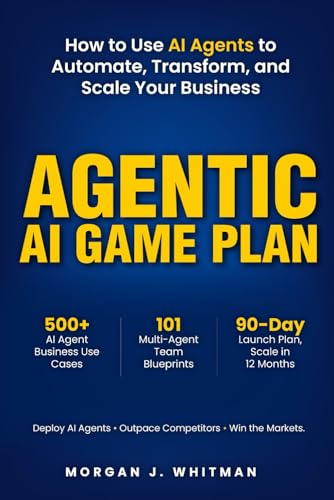
Agentic AI Game Plan is like a practical playbook for real business growth and use of AI. The massive range of use cases and ready-built agent teams sparks immediate ideas for automation and scaling. Clear frameworks, strategic structure, and actionable momentum make it a valuable guide for leaders serious about implementing AI now. As someone who uses AI in my career, this guidebook provides pathways for many more uses.
YZ –
AI is the future of business
I picked up Agentic AI Game Plan because I was still not clear about all the ways AI can be used in business. The “game plan” approach really helped me to understand. It breaks down complex ideas into something practical and actionable. I especially appreciated how it balances technology with people, governance, and real business use cases. It left me thinking differently about how AI agents could actually create an advantage, not just noise. I recommend to anyone trying to get ahead of where AI is going.
Shek A. –
Practical Clarity in a Very Noisy AI Space
I liked the emphasis on deployment timelines, risk, and governance, which gives it a very operational feel, like a playbook rather than thought leadership. The six “divisions” help break down a massive topic into manageable lanes, especially for leaders juggling multiple priorities. The agent team examples stand out—not because they’re flashy, but because they feel realistic, even conservative at times. That restraint makes the ideas easier to trust.
One person found this helpful
JayTee –
Realistic Game Plan
I expected this book to feel overwhelming, but the information was surprisingly clear and easy to understand. The Game Rules chapter stood out to me because it framed AI as a structured, strategic plan rather than something abstract or intimidating. I especially appreciated the explanation of how AI gradually gains decision-making ability and operates with less human guidance. Then, after seeing that explanation, I compared ChatGPT and Google. Ever since ChatGPT came to be, I’ve been relying on it more than Google, and I can see why so many people, including myself, see how successful ChatGPT is compared to Google. Overall, this book is a smart, eye-opening read on AI.
One person found this helpful
A. A –
Practical Playbook for Turning Agentic AI into Real Business Results
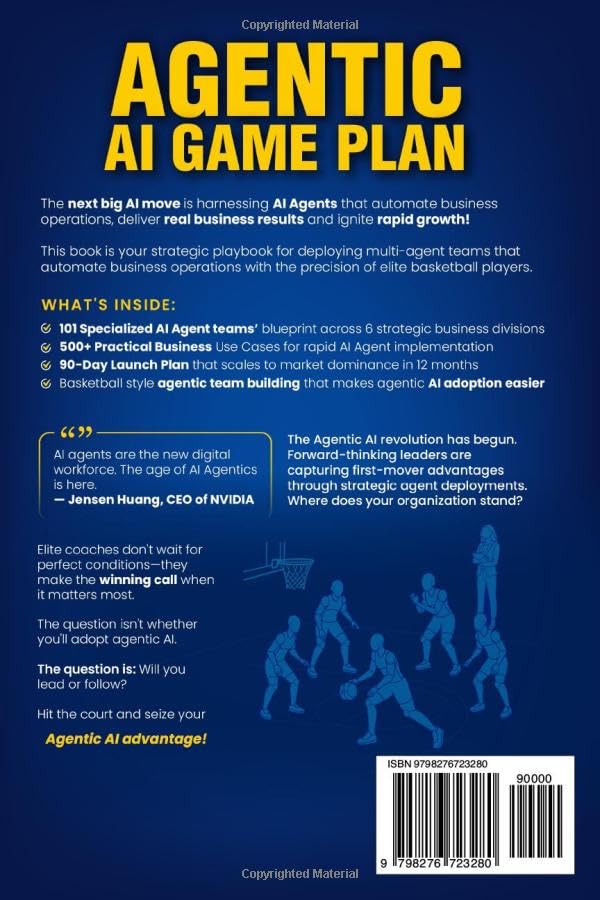
I think this book stands out as a highly practical and execution-focused guide for leaders who want to move beyond AI theory into real-world deployment. With hundreds of concrete use cases, ready-made AI agent team structures, and a clear implementation roadmap, the book makes complex agentic AI concepts accessible and actionable. The basketball team framework is especially effective at simplifying strategy and coordination, while the strong focus on governance, ethics, and ROI keeps the guidance grounded.
shanskan –
A Roadmap for Real AI Progress
I bought this because I felt overwhelmed by all the AI hype and wanted something practical. I have to say, this book gave me a level of clarity I did not expect. I was able to map several tasks in my own business to the examples in the book, which made everything feel less intimidating. I even tried building a small AI workflow after reading one of the sections, and it actually worked. The structure is easy to follow, and the ideas feel doable instead of out of reach. If you want a guide that helps you take real action with AI, this is a great resource.
Stanley –
A Practical Playbook That Actually Delivers
This isn’t one of those vague “AI future” books—it’s a real, usable game plan. The examples are concrete, the frameworks make sense, and the basketball team analogy surprisingly works to break down complex agentic AI concepts. I appreciated how actionable everything felt, especially the agent teams and deployment phases. It’s clearly written for leaders who want results, not hype. If you’re serious about implementing AI in your organization, this book gives you a clear edge.
Brian5150 –
Intro to a new world
I’ve become pretty adept at using the Large Language Model AI interfaces, but learning about AI Agents was like discovering a new world. The writer cleverly structured the book like a basketball league, with separate divisions for different categories of agents. This made it easy to understand how a particular agent might be useful. The options are virtually endless, and I closed the book inspired and curious. The only piece I felt was missing was guidance on how to actually access and launch an agent, but I know that’s info that I can track down elsewhere.
Jenny Swickant –
Seizing the AI Edge in Everyday Operations
This volume positions itself as a field guide for executives, entrepreneurs, and department leads who want to turn autonomous software agents from buzzword into concrete business results. Drawing on more than five hundred scenario-based examples and over a hundred pre-assembled agent teams, it maps where these systems can plug into functions across the organization, from back-office workflows to customer-facing interactions.Whitman organizes the content with a sports-league motif and six themed divisions, each centered on a different pillar of performance. A phased roadmap goes from initial pilots through a 90-day launch and into longer-term scaling over roughly a year, with sustained attention on risk controls, security considerations, and practical human–AI partnership.There is a blend of high-level strategy, detailed checklists, and ready-made agent team configurations that shorten the path from idea to implementation. The book emphasizes concrete roles, process improvements, and technology options that leaders can evaluate immediately. Decision-makers needing a structured, example-rich reference for deploying agentic systems at scale are likely to regard this as a powerful guide to the coming decade.
Jessica Simmons –
No-Hype Playbook for Deploying AI Agents
This book turns “agentic AI” from a buzzword into a checklist. Whitman shows how to pick high-leverage workflows, wire tools, and data safely, and pilot with guardrails before scaling. I liked the clear diagrams, prompt patterns, and failure playbooks for drift, hallucinations, and flaky integrations. The case studies feel real, with simple metrics to prove ROI. It is practical, readable, and focused on momentum – exactly what a busy operator needs to move from demo to dependable system.